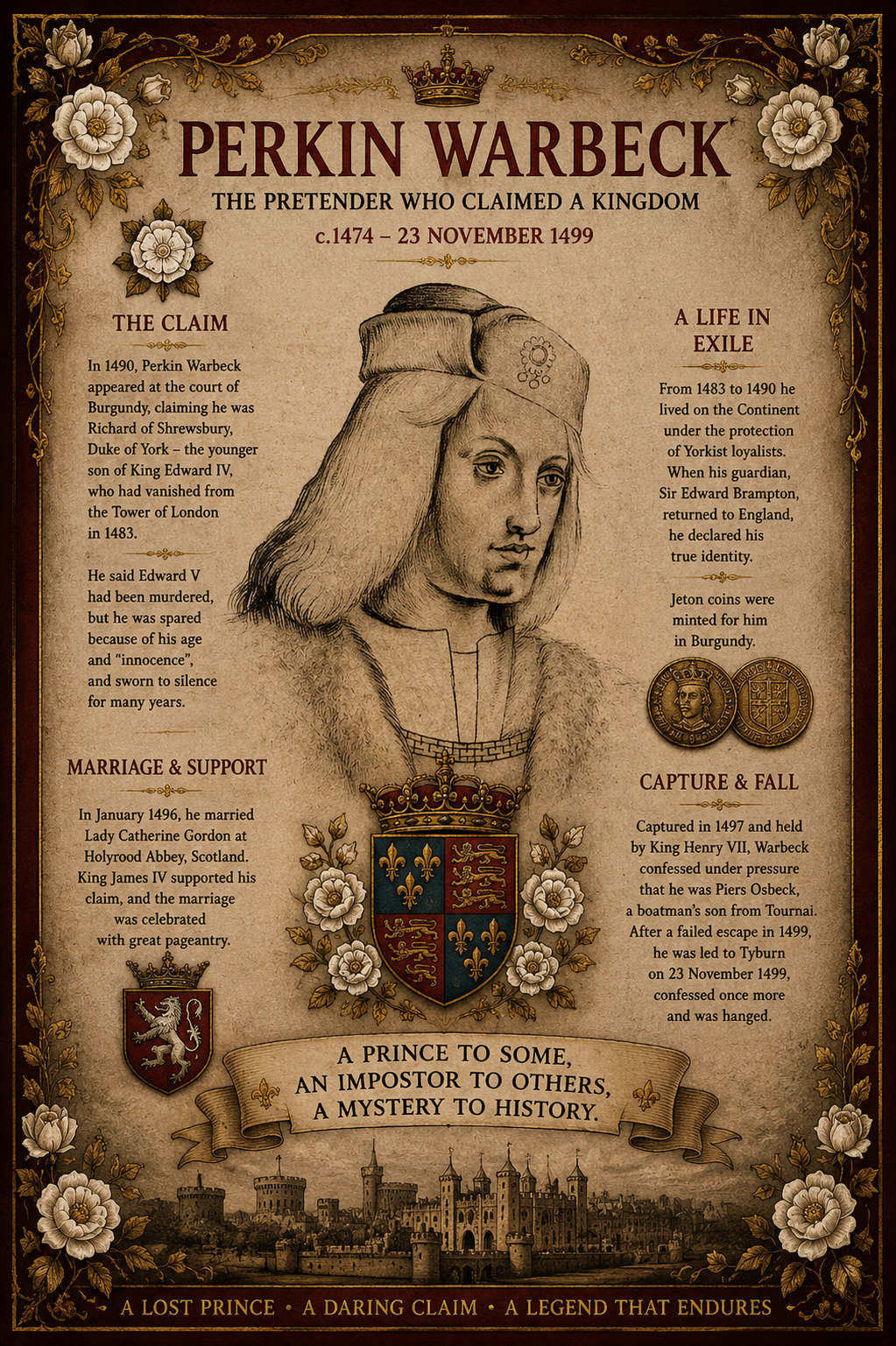

👑 Perkin Warbeck, The Pretender Who Claimed a Kingdom (c.1474–1499)
Explore one of the greatest mysteries of the Tudor age with this museum-style tribute to Perkin Warbeck (c.1474–1499), the enigmatic claimant whose identity has fascinated historians for more than five centuries. Declaring himself to be Richard of Shrewsbury, Duke of York—the younger of the two Princes in the Tower—Warbeck mounted one of the most remarkable challenges to the Tudor dynasty ever recorded.
Inspired by contemporary portraits and late medieval manuscript artwork, this historical print combines elegant heraldic styling with rich antique tones, ivory roses and intricate gold detailing. Designed to encourage curiosity rather than certainty, the artwork honours one of history's most debated figures while remaining faithful to the surviving historical evidence.
Poster Features
Perkin Warbeck (c.1474–1499)
The Pretender Who Claimed a Kingdom
Inspired by contemporary portraiture
Elegant museum-style historical design
Medieval heraldic detailing
Antique gold, parchment and deep burgundy colour palette
Perfect for historians, collectors, genealogists, and enthusiasts of the Wars of the Roses and Tudor history
Ideal for studies, libraries, offices, and historical displays
Historical Significance
First emerging at the Burgundian court in 1490, Perkin Warbeck declared himself to be Richard of Shrewsbury, the younger son of King Edward IV and one of the missing Princes in the Tower. Supported by influential Yorkists, recognised by Margaret of Burgundy, and later welcomed by King James IV of Scotland, his claim quickly became one of the greatest threats to the reign of King Henry VII.
In 1496, Warbeck married the Scottish noblewoman Lady Catherine Gordon, further strengthening the legitimacy of his cause in the eyes of many supporters. Following his eventual capture, Henry VII initially treated him with surprising generosity, allowing him to remain at court under close supervision. After an unsuccessful escape attempt, however, Warbeck was imprisoned once more in the Tower of London before being executed at Tyburn on 23 November 1499.
Before his death, Warbeck signed a confession stating that he was Piers Osbeck, the son of a boatman from Tournai. Whether this confession reflected the truth or was extracted under pressure remains one of the enduring questions of English history.
Today, historians remain divided.
To some, Perkin Warbeck was an exceptionally gifted impostor; to others, he may have been the rightful Richard of Shrewsbury, surviving the fate traditionally attributed to the Princes in the Tower. His true identity remains one of the most intriguing mysteries of the late fifteenth century.
)